terminal
Python Fundamentals
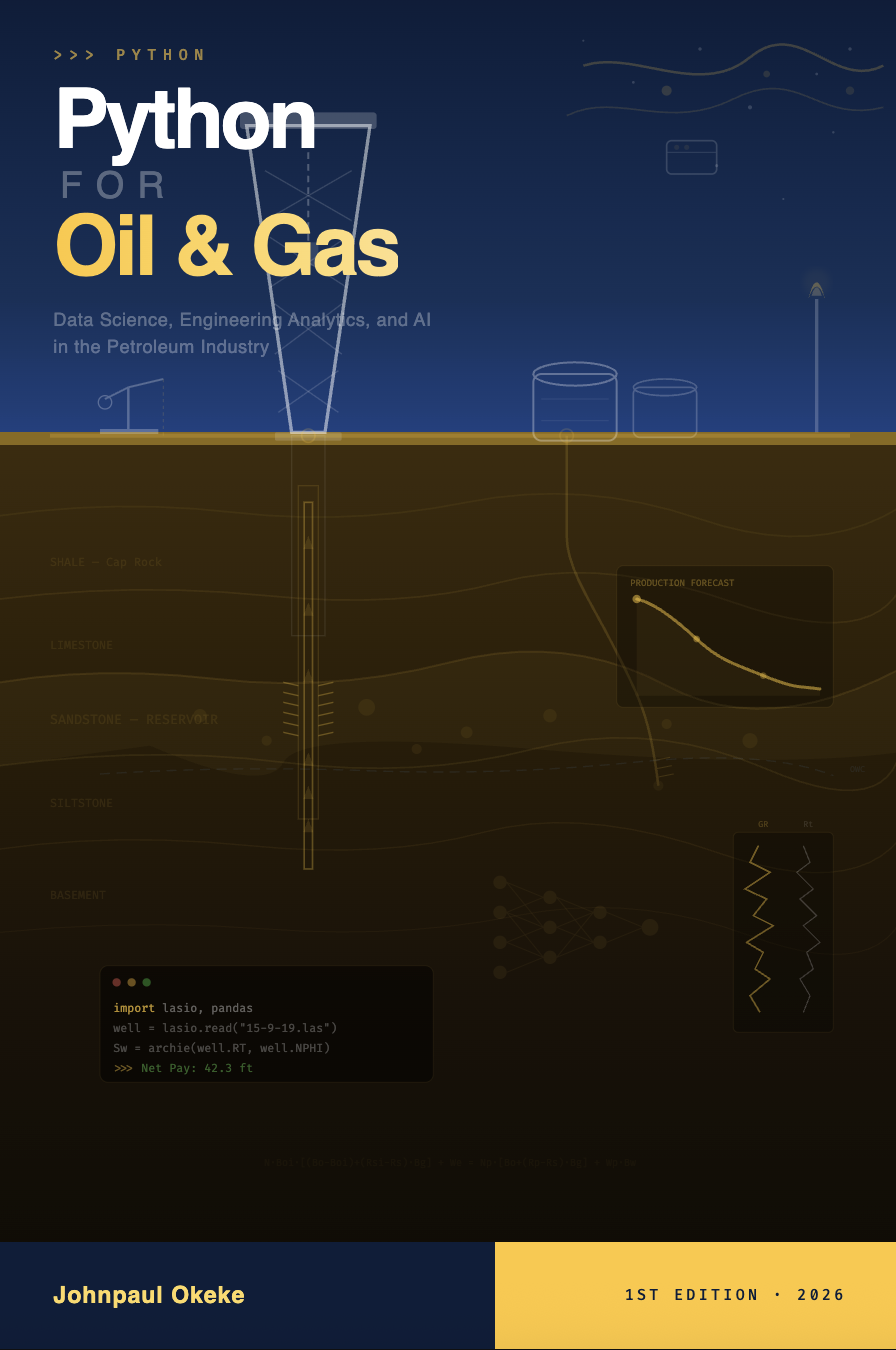
From zero to fluent — variables, functions, OOP, and the scientific stack tailored for petroleum workflows.
1st Edition · 2026
Data Science, Engineering Analytics, and AI
in the Petroleum Industry.
22 hands-on chapters taking you from Python fundamentals through PVT correlations, decline curve analysis, and reservoir simulation — all the way to machine learning and cloud deployment. Built on real Niger Delta field data.
By Johnpaul Okeke · SPE Member
Try it right now — no signup
No install, no account. Change the numbers and hit Run — it executes right here in your browser.
Like that? Create a free account to save your progress across all 22 chapters.
What You'll Learn
Each chapter builds on the last — starting with Python basics and ending with production-grade ML models deployed on the cloud. Every concept is grounded in real petroleum engineering problems.
From zero to fluent — variables, functions, OOP, and the scientific stack tailored for petroleum workflows.
Load, clean, and transform LAS files, production CSVs, and well test data using Pandas and domain libraries.
Compute porosity, water saturation, and net pay with Archie's equation and triple-combo log interpretation.
Apply Arps decline curves, material balance, and nodal analysis to predict well and reservoir performance.
Build supervised and unsupervised models for facies classification, production prediction, and anomaly detection.
Ship production-ready Streamlit and Dash apps, deploy to the cloud, and integrate with real-time SCADA data.
Table of Contents
Every chapter is free to read — chapters 1 and 2 with no signup, the rest with a free account. A book activation code adds the interactive code playground, graded exercises, and downloads.
Part I: Python Fundamentals
Part II: Petroleum Data Engineering
Part III: Reservoir & Production Engineering
Part IV: Machine Learning Essentials
Part V: Real-World Applications
Who This Book Is For
Supplement your petroleum engineering coursework with practical Python skills that employers actually look for.
Automate repetitive calculations, build custom analysis tools, and make data-driven decisions faster.
Apply your existing programming skills to the energy sector — one of the world's largest and most data-rich industries.

About the Author
Petroleum engineer, SPE member, and the lead developer behind PhiDrillSim — a Python-based drilling simulation engine that models torque-and-drag, hydraulics, and rate-of-penetration in real time. Former VP of the NGA UNILAG Student Chapter, where he organized technical workshops bridging petroleum engineering and modern software practices.
His work focuses on what he calls “Industrial Intelligence” — applying Python, data science, and AI to solve real problems in the Nigerian oil and gas sector and beyond. This book distills that experience into 22 practical chapters.
Pricing
The whole book is free to read, and you can run every exercise in your browser. One simple upgrade unlocks the parts you take with you.
$0
Read & run — free forever.
$20
One-time — yours for good.
Python tips for petroleum engineers, early access to new chapters, and case studies from real Niger Delta field operations.
No spam. Unsubscribe anytime.